
Dr Jordan Potts, Senior Development Scientist
Introduction
Spray drying is a well-established and highly versatile technology in the development of inhaled drug products, enabling precise control over particle size, morphology, and composition. Inhalable drug delivery uses spray drying due to its ability to produce engineered particles with tailored aerodynamic properties, while forming homogeneous mixtures of excipients and active pharmaceutical ingredients (APIs) that enhance stability and solubility.
Among functional excipients, L-leucine has gained particular importance in dry powder inhalation (DPI) formulations. As a hydrophobic amino acid with low aqueous solubility, L-leucine preferentially migrates to the air–liquid interface during spray drying. As solvent evaporation proceeds, it crystallises at the droplet surface, forming a shell-like structure. This surface enrichment improves dispersibility, reduces interparticle cohesion, and enhance resistance to moisture uptake.
However, the degree of L-leucine surface enrichment and its impact on particle structure depend on formulation composition. In multicomponent systems, excipients may compete for interfacial localisation, particularly when surfactants or amphiphilic components are present. Understanding how L-leucine concentration influences both the internal morphology and surface chemistry of spray-dried particles is therefore critical for rational formulation development.
Study Aim
This study examines the effect of L-leucine content on the internal and external morphology of spray-dried particles using a combination of Focused Ion Beam Scanning Electron Microscopy (FIB-SEM) and Time-of-Flight Secondary Ion Mass Spectrometry (ToF-SIMS). These complementary techniques provide insight into structural evolution and surface composition as a function of formulation.
Formulation Design
A series of six formulations was developed to systematically investigate the impact of L-leucine concentration. Each formulation contained 1% (w/w) caffeine as a model API, with varying proportions of trehalose and L-leucine. A surfactant-containing formulation was also included to explore excipient interactions.
Formulation | Composition (% w/w) |
1 (Control) | 1% Caffeine, 99% Trehalose |
2 | 1% Caffeine, 94% Trehalose, 5% L-Leucine |
3 | 1% Caffeine, 86.5% Trehalose, 12.5% L-Leucine |
4 | 1% Caffeine, 79% Trehalose, 20% L-Leucine |
5 | 1% Caffeine, 49% Trehalose, 50% L-Leucine |
6 | 1% Caffeine, 85.5% Trehalose, 12.5% L-Leucine, 1% Polysorbate 20 |
Trehalose acts as the primary matrix-forming excipient, while caffeine serves as a model compound to track API distribution. The inclusion of polysorbate 20 (PS20) provides insight into how surfactants influence surface enrichment and morphology.
All formulations were processed using a Büchi B-290 spray dryer under controlled conditions.
Analytical Approach
The study utilised a dual analytical strategy to characterise both structure and composition.
- FIB-SEM for Morphological Analysis: FIB-SEM (Zeiss Crossbeam 550) was used to investigate both external particle morphology and internal cross-sections. Milling was performed at 30 kV / 700 pA, with SEM imaging conducted at 2 kV / 200 pA. This approach enabled direct visualisation of internal porosity and structural features.
- ToF-SIMS for Surface Composition: Surface chemical composition was analysed using ToF-SIMS V (IONTOF GmbH) with a 25 keV Bi₃⁺ ion source. Measurements were conducted in static mode over 50 × 50 µm² This technique provided high-sensitivity detection of component distribution at the particle surface.
Results and Discussion
Evolution of Internal Morphology
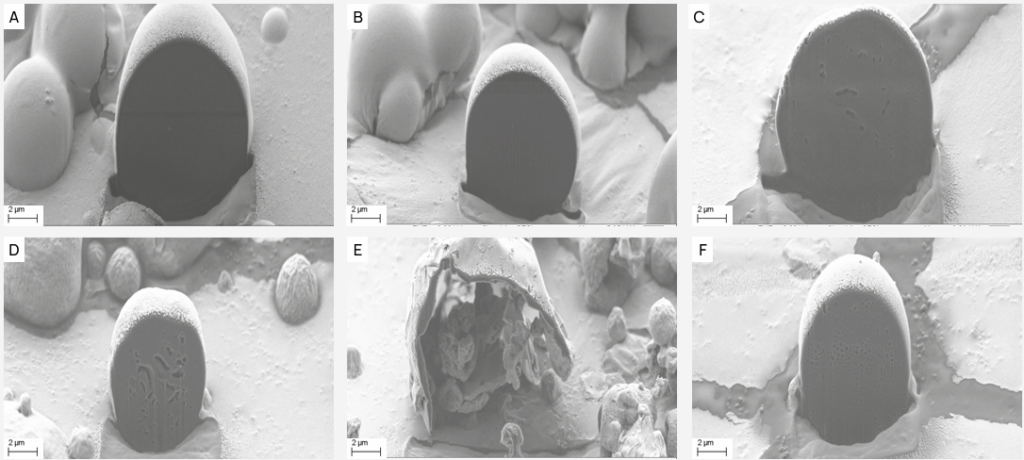
FIB-SEM cross-sectional analysis demonstrated a clear relationship between L-leucine concentration and internal particle structure. At low concentrations, specifically in the control and 5% L-leucine formulations, particles exhibited dense and relatively uniform internal structures. These findings indicate that minimal L-leucine content does not significantly alter droplet drying behaviour or structural development.
As L-leucine content increased to 12.5% and above, particles began to exhibit increasing levels of internal porosity. Voids and cavities became more pronounced, suggesting that surface enrichment of leucine influences solvent evaporation dynamics and promotes the formation of porous structures. This trend continued with increasing concentration, with the 20% and 50% formulations showing progressively greater structural heterogeneity.
At the highest concentration investigated (50% L-leucine), particles exhibited clear signs of fragmentation and collapse. This suggests that excessive surface enrichment may lead to a rigid but unstable shell, compromising overall particle integrity.
The formulation containing polysorbate 20 showed a distinct internal structure compared to its leucine-only counterpart at the same concentration. The presence of the surfactant resulted in more uniform porosity, indicating that interfacial modification during drying plays a significant role in determining final particle architecture
External Morphology
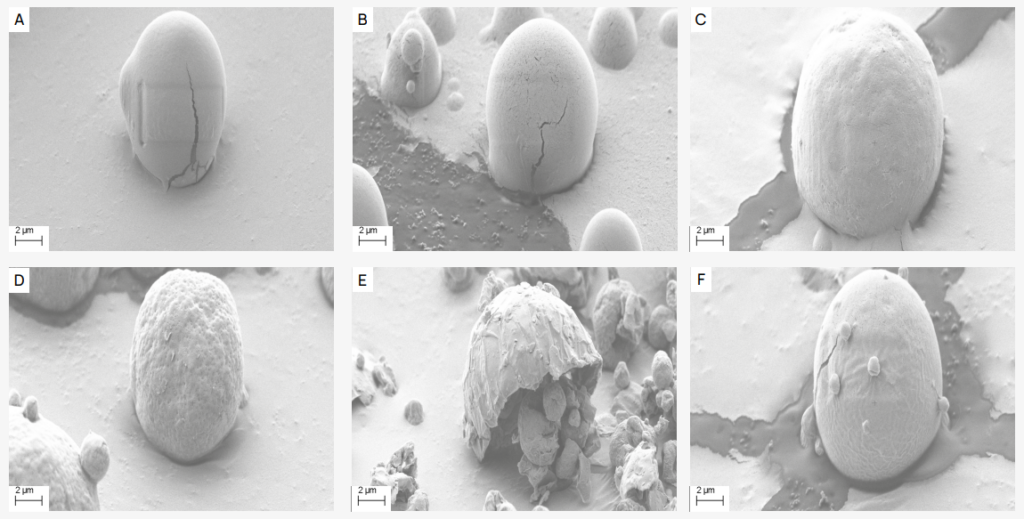
Changes in internal structure were reflected in the external morphology of the particles. Low L-leucine formulations produced relatively smooth and spherical particles. As L-leucine content increased, surface roughness became more apparent, consistent with the formation of a surface-enriched shell.
At high concentrations, particularly at 50% L-leucine, particles displayed fractured and irregular surfaces, aligning with the fragmentation observed internally. These findings highlight the impact of excipient concentration on both particle formation and mechanical stability.
Surface Chemical Composition
ToF-SIMS analysis provided detailed insight into the distribution of formulation components at the particle surface.
A clear and consistent trend was observed in which L-leucine surface signal intensity increased progressively with concentration, while trehalose signal intensity decreased. This directly confirms preferential surface enrichment of L-leucine, supporting its role in forming a protective outer shell.
The inclusion of polysorbate 20 further influenced surface composition. In the presence of the surfactant, trehalose surface signals were reduced, while L-leucine enrichment was enhanced relative to the equivalent formulation without PS20. This demonstrates that surfactants can significantly alter interfacial competition, reinforcing the formulation-dependent nature of surface structure.
Caffeine, used as a model API, exhibited consistently low surface signal intensity across all formulations. This indicates that it remains predominantly localised within the particle core. This distribution is advantageous, as it suggests that L-leucine forms a protective shell around the API, potentially improving stability and limiting surface-mediated degradation.
Conclusions
This study demonstrates that L-leucine content is a key determinant of both internal morphology and surface composition in spray-dried particles. Through the combined use of FIB-SEM and ToF-SIMS, it was possible to correlate structural changes with compositional distribution, providing a comprehensive understanding of particle formation.
The results confirm that L-leucine acts as a surface-active excipient, promoting shell formation and influencing internal porosity. However, its effects are highly dependent on concentration and formulation context, requiring careful optimisation to achieve the desired balance between performance and stability.